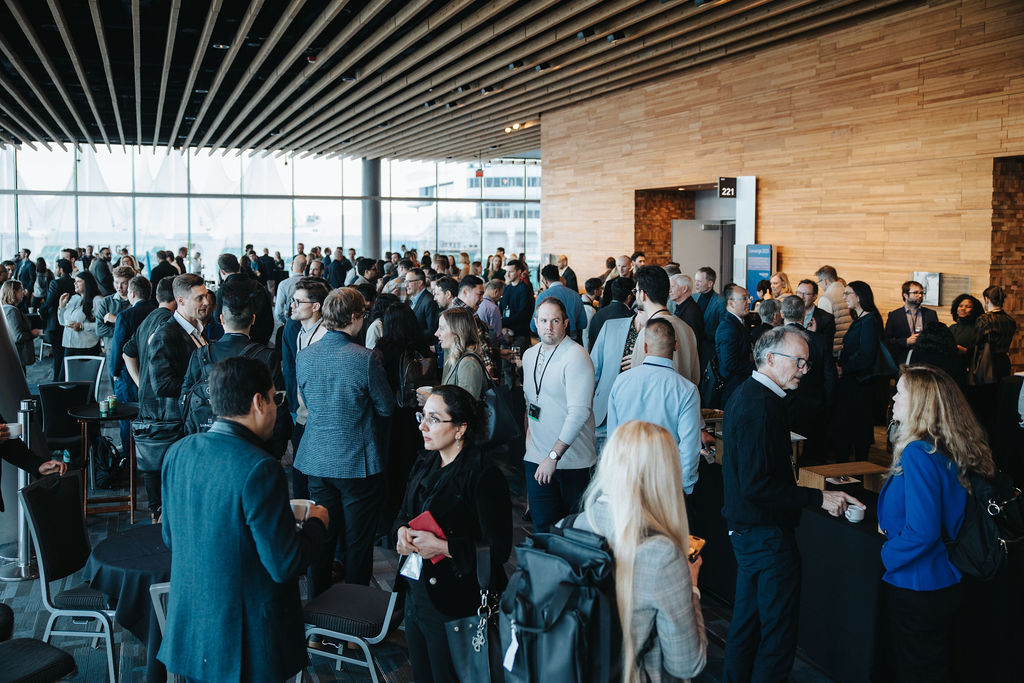
Converge 2025 made one thing clear: Canada’s climate tech ecosystem is aligning around execution. Across founders, operators, communicators, investors, and policymakers, there was a shared understanding of what it takes to break through today’s environment, and what Canada needs to lead.
Throughout the day, conversations kept coming back to several main themes that are shaping the next decade of climate innovation:
Communicating your impact in a noisy world
In the current media landscape, credibility and clarity matter more than ever. Communications experts and editors underscored the same point: the companies winning attention are the ones communicating with authenticity, discipline, and proof.
Key takeaways:
- Reporters want specificity: data, deployment milestones, customer results. Your story must be anchored in evidence and real outcomes.
- In between major company news and announcements, show progress and stay visible through your owned channels. Media will look to these channels when determining whether to tell your story when you pitch.
- Founders need to own their narrative early, before others define it for them.
The strongest messages are simple: What problem are you solving? Why does it matter now? Who says so besides you?
The brave new world of FOAK
FOAK has never been easy. In climate and industrial tech, it’s where technical ambition meets financial, regulatory, and operational reality — and the crucial bridge between promising tech and commercial scale.
Across sectors, founders highlighted the same realities:
- FOAK isn’t just a technical milestone, it’s a financial, operational, and permitting feat.
- Success depends on early customer alignment, credible economics, and a clear path to repeatability.
- FOAK timelines must reflect both urgency and realism; overpromising creates risk for the entire sector.
Canada’s advantage? A policy environment and set of industrial partners increasingly willing to co-create FOAK pathways — if companies design for real-world constraints from day one.
Scaling climate tech: from prototypes to products customers trust
Scaling climate tech requires more than great science. It requires building something customers want to operate in the real world — reliably, safely, and at cost.
What we heard:
- Scaling starts with deep customer understanding, not just the technology.
- Economics must be validated early; investors are looking at business models, not just breakthroughs.
- Repeatability is the real unlock: companies that design processes that work across multiple sites scale faster and raise more efficiently.
Scaling depends on early alignment across the full value chain — suppliers, offtakers, manufacturers, and end-users. Saad Dara from Mangrove Lithium captured this clearly:
“We will all be more successful if the rest of us are there as well to support each other.”
Teams that build with customers and ecosystem partners from day one reduce friction and accelerate repeatable deployment.
The shift underway is clear: founders are building for deployment, not just discovery.
Dual-use technologies are emerging as a strategic advantage
More companies are developing solutions that serve both climate and national resilience needs — from wildfire tools to critical minerals to advanced materials.
The dual-use takeaway was simple:
- Investors are looking at solutions that reduce emissions and strengthen security, safety, or infrastructure.
- These companies can access more customers, more funding pathways, and more channels to scale.
- But credibility matters, dual-use only works when the climate impact remains a priority, not diluted.
Canada’s unique assets make it an ideal place to build and test dual-use solutions. David Yeh underscored this in his fireside chat, pointing to clean power, globally competitive talent, and policy stability as reasons companies are now looking to Canada for deployments.
The Road Ahead
Converge 2025 left attendees energized and aligned on what it takes to win in the next decade of climate innovation:
- Tell your story clearly and with evidence.
- Build FOAK projects that are financeable and replicable.
- Design for customers and real operating environments.
- Lean into dual-use opportunities that strengthen resilience and climate outcomes.
- Treat partnership as a core strategy — not a nice-to-have.
Our climate tech sector isn’t emerging anymore.
It’s advancing — with urgency, clarity, and a shared commitment to scale.
Thank you to everyone who joined as at Converge 2025!